Showing posts with label rough sleepers. Show all posts

Friday, 24 October 2014

How do we manage our expectations when working with homeless clients?

One of my colleagues asks this every so often and it gets me thinking and keeps me in check.
It could be in relation to someone you have just met or one of your 'famous faces ' that had acted unacceptably or sabotaged their opportunities. How does this make you feel? I feel cross at them and at myself.
But when someone has been doing so well or been given a great opportunity and lost it, should we look more deeply into the situation. It often feels like we put a lot of pressure on our clients to succeed. But is that the reason why they do not? Is the pressure too much to live up to? What if they do succeed, but then loose it all again and are back to square one? How would any of us cope in that situation?

For some of our clients they may be in a cycle of homelessness. They live on the streets, hostels and then prison/hospital, then back on the streets. Has their normally shifted to something we would recognise as surviving. All three environments are hard to live in, they all result in various liberties being taken away, from a safe place to sleep, who you sleep with or the choice of when to sleep, to name a few.

I feel the only way I can restore my motivation is to look at any situation, even a negative one and see where we can learn. Maybe adding extra or a different type of support. For those that seem to be revolving through various services and institutions, I can only aim to try to be available and consistent. By letting them know that I have not given up, regardless of the result of their recent activities and that I will continue to work with them. However, I always look for them to recognise their behaviour and accept their mistakes. Once they have 'owned' it, we can move forward with a new plan to address whatever their priorities may be, housing, health care, finances, etc.

The hardest part is when they do not acknowledge their own hand in recent actives and continue to blame others or may me for the situation they now find themselves in. I will always make a point of apologising or owning up to any mistakes on my behalf and so expect them to do the same and aim to instil mutual respect.

Sometimes, it's all about having a little time to cool off. I would always try to rebuild a broken relationship and would give it time and be persistent. I always try to remember that some of our guys have been living like this for years, maybe all their life if they have been in the care system as well. They are used to workers coming and going, good one s and bad ones.

How do I manage my expectations? Always optimistically but, while being realistic at the same time.
"The sun is always shinning above the clouds" Paul F Davis

Thursday, 14 April 2011

Will the end of the Workers Registration Scheme help those already rough sleeping with 'No Recourse to Public Funds' ?

As of 1st  May 2011, the worker's registration scheme will no longer exist. This currently effects A8 Nationals living and working in Britain (A8 countries are Czech Republic, Estonia, Hungry, Latvia, Lithuania, Poland, Slovakia and Slovenia). It means that as of this date, A8 nationals will have the same rights as other EEA (European Economic Area) Nationals in this country. See Directgov for EEA and A8 info

Currently A8 nationals cannot access Job Seekers Allowance (JSA) until they have worked for 12 months in accordance with the Workers Registration Scheme (WRS) and have to pay £90.00 to register on this scheme. They can not access benefits unless under the WRS and have completed 12 months of employment. For those that have not completed 12 months of employment required due to illness or unemployment, they are not entitled to benefits until they can complete the allocated time in employment.

The biggest changes to the cancelling of WRS is that A8 Nationals can now register for income based JSA (as long as they meet the same criteria as  British Citizens accessing benefits). They should also be entitled to Housing Benefit and Council Tax Benefits.

While researching this issue I have been unable to understand how this effects those A8 Nationals already in this country. Much of the documents I have read comes from the perspective of someone newly entering the country.

Will this impact on those already rough sleeping? Will this solve many of our issues regarding those sleeping out who have No Recourse to Public Funds? How does it work in practice?

Friday, 18 March 2011

Show your support for Soup Runs

There will not be a discussion on The Spike this week, instead please show your support for 

Soup Run Street Party on the Piazza.

Following on from a recent discussion on The Spike, regarding Westminster City Council planning to ban soup runs, it also seems they are  proposing a by-law to ban rough sleeping and giving to the homeless. 

There will be a street party for anyone wanting to attend, to " celebrate the positive impact of soup runs and groups giving to the homeless in Westminster, with food, music and fun provided!"

They will be meeting at  2pm on 20th March at Westminster Cathedral Piazza.

To find out more and to offer your support check out their facebook site or email lids@sockmob.org.uk

Wednesday, 23 February 2011

Will the results of the latest street counts help to identify important services which should be protected from government funding cuts?

It seems that although some local authorities undertook street counts and others made estimates, the results from last years rough sleeper counts have been worthwhile.
A recent Homeless Link document (Rethink cuts-call to local authorities with high levels of rough sleepers) states that the results show both regional differences in homeless numbers and a connection between the recorded numbers and the current economic performance of a region. It highlights "rough sleeping in rural agricultural areas where the economic downturn has left Central and Eastern Europeans workers destitute when work contracts have run out" also areas such as  "Kensington and Chelsea, which is another authority planning substantial cuts, reported its highest number of rough sleepers since data has been collected". It explains that by using estimates as well as actual counts areas can highlight the need for more government funding in order to deal with homelessness issues.
Homeless Link suggest that cuts to funding would seriously undermine progress already achieved, stating that "A time of budget cuts should be a time to focus resources on the most vulnerable people, not a time to cut away the lifeline services and those enabling them to rebuild their lives.”

 
Will these new results help to stream line services and assist others to prove that the work they are already doing is vital to the success of ending homelessness?

Friday, 4 February 2011

Rural Homelessness


A recent article in Inside Housing suggests that homeless acceptance has increased by 25% in rural areas.
 
Along with ‘sofa surfers’and ‘squatters, rural homelessness is often considered as another category of ‘hidden homelessness’. As with many inner city areas, poverty, alcohol and drug abuse, as well as mental health issues, are associated with rural homelessness. However, rural services seem to have less funding and presence within the community than many of their urban counterparts. It therefore seems that many rural areas struggle to provide adequate support to the homeless clients.
 
Homeless Link have produced a document on service provision in rural areas which highlights many of the challenges faced. It also suggests ways services can improve and recommends looking at:

  • identifying specific needs that may differ in rural areas compared to more built up ones
  • how services can be accessed and if they are beneficial to service users and the community
  • whether particular services can work effectively in a rural area.
 
Having worked as an outreach worker in an urban environment I have limited knowledge of rural homelessness.  I would therefore be very grateful to learn what experience readers have had in rural areas and suggestions to improve these services?
 

Wednesday, 26 January 2011

Homelessness and Health

There are several debates about the average life expectancy of a rough sleeper but what are the real issues affecting their health.

Maintaining general good health on the streets can be difficult, as there is little chance to rest in order to recover from an illness. Health issues can creep up slowly in the form of diabetes (which is often hard to recognise at first by an individual) hep B or C, or HIV. Due to the nature of services provided it may not always be possible to get healthy and nutritional food, so inevitably overall health is affected. 

Accessing medical services should not be too hard as most areas with a recognised homeless population should provide suitable support services. These may include drop in sessions at a day centre, hostel, or in some cases,  a designated surgery for homeless clients.

Managing medication can be tricky, especially if there is nowhere to store it. Many day centres dislike handling or storing medication and GP surgeries are reluctant to provide daily prescriptions. Depending on the medication, it can be very valuable on the streets and can quickly be stolen.

Whilst not all rough sleepers will experience these problems, Outreach Workers need to be aware of these issues and thoroughly asses rough sleepers in order to identify appropriate support services.

Please comment and share your knowledge.

Sunday, 9 January 2011

Helping rough sleepers and homeless clients throughout the year.


During the Christmas period, homeless organisations received great and valuable support from the general public. Many received donations of clothing, food, bedding, and money. But will this support continue as the year progresses? I fear that whilst the cold weather and life on the streets continue the levels of support will quickly dwindle. 

  How can we encourage the general public to help rough sleepers and homeless clients throughout the year? What can the public do as part of their every days lives, regardless of the time of year, to help tackle homelessness? 

Friday, 24 December 2010

Merry Christmas and a Happy New Year from The Spike

We would like to thank  everyone who has followed and commented on The Spike this year. We have had a really successful start and hope the New Year is just as positive.

Although many Governmental services around the country are closed, we realise that many voluntary and charity organisations are busy during the Christmas period. If you would like to tell us about the great work that many people are doing over this holiday period, we would love to know.

Also, please let us know about any services that are available, that would otherwise be forgotten about, for rough sleepers and homeless clients.

Once again, Thank you, we really appreciate your support. Please keep on spreading the word about The Spike.

Wednesday, 8 December 2010

How important is a local connection when finding accommodation for homeless clients?

Many hostels and accommodation providers around the country have waiting lists, as the services they provide are so much in demand. But many of these will have specific criteria when considering applications. One main factor is whether the individual has a local connection to the area. This is particularly the case with councils and Local authorities when assessing duty of care.
However, by prioritising those with a local connection we seem to be making it more difficult for people to travel around the country. The reasons for moving from one place to another can be as simple as freedom of choice, to be closer to family and friends, or to leave an old lifestyle behind.

Although I understand the need to deter people flocking to particular areas, it seems that we are denying them the right to choose where they live. If they are intent on moving to a specific area, they will be forced to sleep out in a new and unfamiliar environment.

Should hostels and accommodation providers be more open to those with local connections, or is it merely a way of preventing a flood of new comers, which could over burden particular areas and services?

Tuesday, 9 November 2010

Are we able to solve the problem of the 'revolving door' of homelessness?

Several years ago homeless organisations acknowledged the issue of ‘the revolving door of homelessness’. Through much hard work and cooperation with other agencies specific situations were identified, which were believed to be the contributory factors of the ‘revolving door’.The main body of these factors seem to be  multiply linked to the criminal justice system, mental health issues, substance misuse, and homelessness.

In 2007 St. Mungo’s and Revolving Doors Agency (RDA) went into partnership and piloted a scheme in Islington, so as to identify ways of improving support and link work between agencies, “to prevent people from spiralling into a cycle of crisis, crime and mental health problems". Click here for link.  It seems that this scheme showed some very positive results.

Now in October 2010, the Government are looking for further ways to tackle this issue, and have identified the issue of rehousing ex-offenders upon release. Click here for link.

While I understand that the lack of access to accommodation can be a contributory factor to re-offending rates, I don’t see how we can be specifically identify private sector accommodation as the solution to this issue. There is already pressure on the agencies to find appropriate accommodation options for homeless clients, within a limited stock of housing resources.

Can we be doing more to improve links between agencies and for service users or is the ‘System’ partly responsible for this ‘revolving door' of homelessness? What are the solutions?

Tuesday, 2 November 2010

Are sponsored sleep outs a good way of highlighting homelessness?


There seems to be a growing trend by some homelessness agencies to raise funds and highlight the issues of homelessness by organising sponsored sleep outs. Most recently the new president of the YMCA, Sir Richard Dannant, slept out along with Norfolk’s High Sheriff Charles Barratt and Judge Phillip Curl. Click here for link and short video 
While I commend those who try to accurately experience a night on the streets, I feel despair when I hear about those who turn a sponsored sleep out into some kind of camping holiday, all night street party and publicity stunt. For people that have to sleep rough this kind of fund-raising may be seen as patronising and very disrespectful.
 
 It seems that fund-raising teams are running out of ideas. Maybe we (the readers of The Spike) should help them out with a few suggestions, that would be less disrespectful to rough sleepers and those that sleep out in the cold every night.

Monday, 25 October 2010

How will the Community Spending Review cuts really affect homelessness and what are the solutions?


It seems that there are several different ways the Community Spending Review will impact upon homeless clients:   
  • Changes to Housing Benefit payments. Anyone under 35 years old (previously 25 years old) will receive just enough to cover the cost of a shared house. Will this affect those living in hostels? How will it affect those single people already in independent accommodation settling after years of homelessness?
  • Council Tax Benefit is to be reduced by 10%. How will this affect those already struggling to keep up with household bills and payments?
  • Changes to ESA (Employment Support Allowance) and JSA (Job Seekers Allowance) payments depending on contributions made and length receiving specific benefits. How will this affect those most vulnerable and unable to work?
  • Less funding for probation services, yet fewer people sent to prison. Where do offenders get support from and where is the incentive to prevent people reoffending?
Please comment if you can identify any more areas relating to homelessness that will be affected by the spending review, with any comments for solutions.

Monday, 18 October 2010

End rough sleeping by 2012. Is this realistic?

The government (London Delivery Board) have stuck to its plan of ending rough sleeping in London by 2012. It initially began by targeting entrenched rough sleepers and is now planning to open something called The Hub. Which would seem to act as a short stay hostel for rough sleepers (three nights max). See Inside Housing link for further details.Click Here

 If we consider the many ways in which people become homeless and the issues they face, as well as the lack of accommodation, is this a realistic plan? For many outreach workers it can be almost impossible to get access to accommodation at short notice. Although I understand the importance of reducing the length of time people are on the streets, additional resources need to be provided by the Government to enable outreach workers to tackle this issue head on. At the moment I don’t see any commitment from the government to provide additional resources.
 I wonder if the sceptics are right when they say that this commitment to reduce homelessness to near zero is an excuse to tidy up London before the 2012 Olympics and less about the social injustice of people falling through the net and having to live on the streets until help finds them.

Tuesday, 12 October 2010

Do front line homelessness workers need vocational qualifications?

Engage to Change has been developed by Homeless Link, Broadway and CIH (Chartered Institute of Housing) and is a qualification for people working in homelessness services. The course includes topics such as Professional Practice Skills, Client Involvement, Homeless Services and Prevention, Addressing Need, Building Capacity and Promoting Choice. See the link below for more information about the course. 
All homelessness front line workers should have CRB checks (Criminal record bureau), but do they need formal recognition and professional standards? Most outreach workers bring with them their own experiences (personal or employment) and knowledge to the job and find that the skills required are vast ranging. Does this course build on their already broad skills base or is it a professional label?
Will it assist workers in their job, and help to reduce homelessness by creating more effect working?

We would particularly love to hear from anyone that has done or is doing the course.

Monday, 4 October 2010

Why are there so few housing options for homeless couples?

Although a high proportion of rough sleepers are single men, there are times when, despite all the odds, people form relationships whilst on the streets. From experience, working with couples can be very challenging. It is the responsibility of an outreach worker to undertake an assessment for each individual and ensure each persons needs are fully understood. However, at no stage of the assessment process is the relationship status of an individual considered. A joint plan must be decided between the couple with regards to accommodation. This is all achievable until a search for hostels is undertaken and it becomes evident that there are only a handful of places in the country that take couples and when they do, there is never a guarantee that two beds are available on the same day.

Why are there so few hostels willing to accept couples? Is it the complicated nature of clients being in relationships, or is it all about housing benefits, bed spaces and allocations?

What are the other options for couples if there aren’t any suitable facilities in their area? Should homeless couples be forced to either sleep on the streets until they can access local authority housing (if they are entitled to it), or end their relationship?

Monday, 27 September 2010

No Recourse to Public Funds and Homeless

What services are available to those who are homeless and have no access to public funds?
The Home office has produced a document stating exactly what people can and can not access regarding benefits, which is a good starting point. Please see attached link.

For outreach workers and front line staff who have contact with rough sleepers and homeless clients, this is not enough information. We need to know what other services are out there so that people can eat, sleep and survive.

First, the age old debate of soup runs and food hand outs and whether they encourage people to maintain a life on the streets, or assist people by providing access to a valuable source of free food. For those that have no money, for whatever reason at least it is an opportunity for them get clean and healthy food, instead of starving, raiding bins, or worse cooking and eating rats (see blog discussion from the week of 12th September
http://thespike2010.blogspot.com/2010/09/expulsion-of-homeless-eea-nationals.html ).

Secondly, using day centres. Where people can make contact with local services (usually outside agencies have regular sessions, such as nurses, mental health workers, benefits advisors or legal advice) which they may otherwise feel unsure about accessing. Day centres usually have a clothing store, washing facilities and offer hot drinks, some also allow service users to use them as a care of address.

But, What else?
Women with no recourse to funds and who are trapped in relationships which are possibly abusive or violent, there is little help as refuges tend to require their service users to be on benefits. The Women’s Resource Centre has been campaigning for action, Click Here 
Those who need medical care, there is the option of accessing an HC1 or HC2 form, which can help with the cost of prescriptions, dental treatment, sight tests and paying for glasses, travel to and from hospital for treatment or for wigs and fabric supports. (Please note, I can not confirm that applications for these items are always accepted, as I have not used these forms. I would like to hear about applications that others have made and if they have been successful).

Any other suggestions would be much appreciated, please add your comments.

Tuesday, 31 August 2010

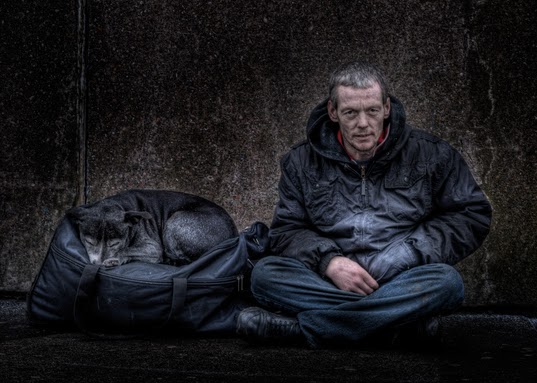
Homeless Clients and Dogs


For many rough sleepers parting with a dog is inconceivable. We know that the relationship between an owner and a dog can be a strong one, providing an emotional bond, personal safety and security, it can alleviate loneliness and even raise self esteem. There are some very good services which support homeless clients to look after their pets, such as The Dogs Trust with their Freedom Project and Hope Project (www.dogstrust.org.uk).
So many hostels still refuse clients with pets, while those that do, have waiting lists.

However there is always more than one side of the story. What about those that have dogs, yet show them very little affection and care? Or clients that are struggling to look after themselves, let alone another being.
Should we be calling the RSPCA or the Dog Warden and what can they actually do? Or should we take matters into our own hands?


(picture by Matthew Halstead http://matthewhalstead.com/ )

Sunday, 15 August 2010

Mental Health Services and Chaotic Rough Sleepers

Chaotic and entrenched rough sleepers can be hard to track down by even the most experienced of outreach and front line workers. Can we really say they that their needs are being fully met? Are mental and physical health services willing to go a step further or do we have to wait for them to become so unwell they 'become a danger to themselves or others'?